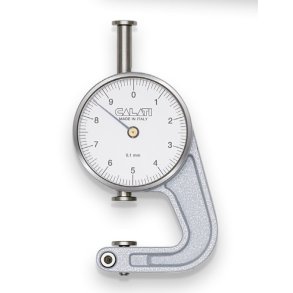
Calati thickness gauges are available with both flat and round contact surfaces, and the choice depends primarily on the material being measured.
Flat contact surface:
- Best for: Hard, flat and smooth materials such as metal sheets, glass, plastic and paper.
- Advantages: Provides an accurate measurement on flat surfaces.
- Disadvantages: May be inaccurate on uneven or curved surfaces.
Round contact surface:
- Best for: Soft, uneven or curved materials such as fabric, leather, rubber and foam.
- Advantages: Adapts better to the shape of the surface and gives a more accurate measurement on uneven materials.
- Disadvantages: May be less accurate on hard, flat surfaces.
General:
- Application: Calati thickness gauges are used in a variety of industries, including the textile industry, leather industry, automotive industry and paper industry.
- Accuracy: Both types of contact surfaces can provide accurate measurements when used correctly. It is important to choose the right type of contact surface for the material being measured.
- Calibration: Calati thickness gauges must be calibrated regularly to ensure accuracy.
Remember to always read the instructions for your Calati thickness gauge for specific information on how to use it correctly.
If you need further information about Calati thickness gauges, you can visit the manufacturer's website or contact a dealer.
| Title | Type | Size | Download |
|---|---|---|---|
| calati_spessimetri-leatherhouse.pdf | 536.87KB | Download |
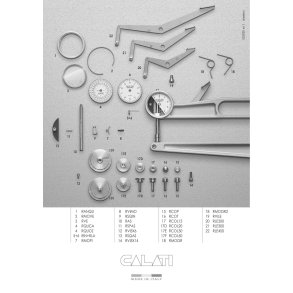
Calati Spare parts - Offer wanted
Skindhuset0317-20
Delivery over 30 days
Price from 0,00 €
(incl. VAT)
Customers who bought this product also bought

Price from 17,20 €
(incl. VAT)